EN
EN  AR
AR 
Executive Summary
The Integrity and Anti-Corruption Index report issued by the “Partners for Transparency” Foundation provides an analytical reading of the reality of integrity, transparency and anti-corruption in 25 countries of the Middle East and the Arab region during the year 2025. The report aims to assess the extent of countries’ commitment to strengthening integrity, transparency and anti-corruption systems, through an analysis of government policies, legislative frameworks and related institutional structures, based on a quantitative and qualitative methodology based on three main sub-indicators: government effectiveness, rule of law and transparency of administration or institutions.
The report affirms that corruption remains one of the most significant structural challenges facing the region, given its direct impact on undermining trust between the state and society, weakening the efficiency of public institutions, and hindering sustainable development efforts. It also indicates that the lack of political will in some countries and weak law enforcement in others have contributed to the entrenchment of systemic corruption, particularly in environments suffering from institutional fragility or protracted political and security crises.
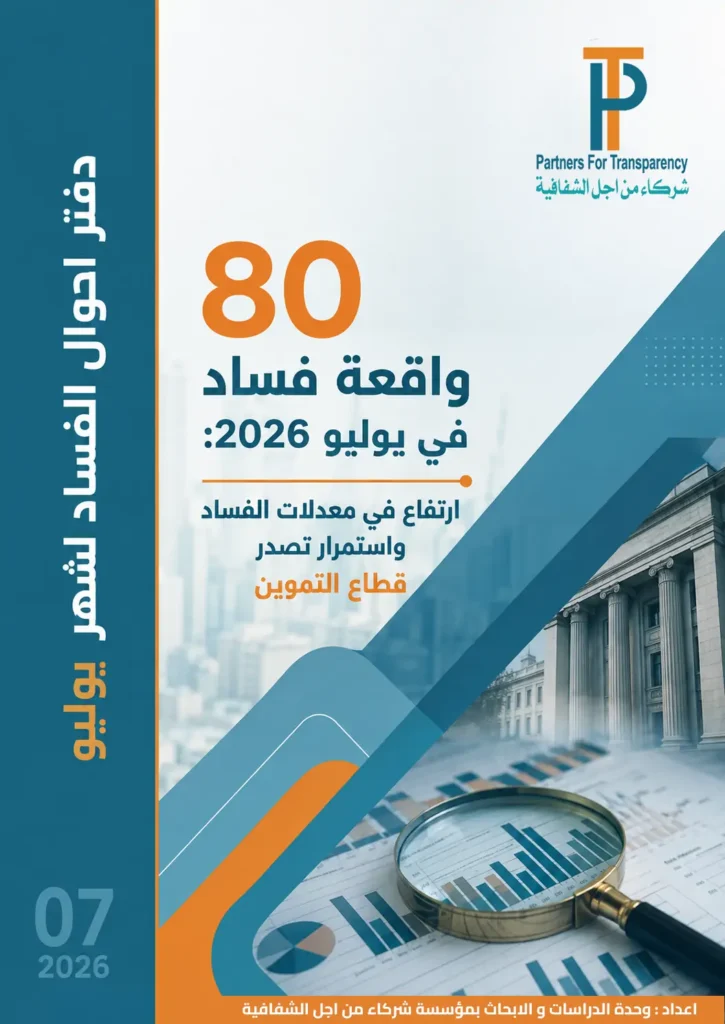
The report's findings revealed a clear disparity in performance levels among the countries surveyed. Only six countries were classified as "safe" in the fight against corruption, while the majority fell into the categories of "stable" and "under threat." The report also documented a total of 464 corruption cases in 2025, of which only 311 were referred to the judiciary. In nearly half of the cases, proceedings stalled at the arrest or investigation stage, reflecting the limited effectiveness of accountability systems in many countries. In this context, Tunisia, Egypt, Algeria, Kuwait, and the UAE stood out as countries that demonstrated relative progress in referring corruption cases to the judiciary, in contrast to other countries that saw virtually no referrals.
The report closely links the level of political and security stability in a country with its ability to implement effective anti-corruption policies, showing that countries with higher levels of stability were able to build more effective legislative frameworks and oversight institutions, while countries suffering from armed conflicts or political unrest recorded low levels in law enforcement and prosecution of those involved in corruption cases.
The report also highlights structural gaps in the area of institutional transparency, particularly with regard to the right of access to information, as a large percentage of countries lack clear legislation to regulate the circulation of information, or open digital platforms that allow citizens to access government data. In addition, there is a weakness or absence of laws for the protection of witnesses and whistleblowers in a number of countries, which limits opportunities to uncover corruption and puts whistleblowers in danger.
Based on its findings, the organization presented a set of recommendations to the countries concerned. Among the most prominent recommendations were a call for the governments of Syria and Sudan to establish independent national anti-corruption bodies, and an urging of countries such as the UAE, Bahrain, Qatar, Oman, Turkey, Iran, Israel, Tunisia, and Mauritania to strengthen the independence of their anti-corruption agencies and ensure the effective implementation of their oversight roles. The organization also called on the governments of the UAE, Bahrain, Iran, Djibouti, Israel, and Sudan to develop effective national anti-corruption strategies with clear objectives and monitoring mechanisms. The recommendations emphasized the need to enact laws to protect witnesses and whistleblowers in Bahrain, Qatar, Oman, Syria, Turkey, Iran, Egypt, Israel, Algeria, Libya, and Somalia, as well as laws regulating asset disclosure and preventing conflicts of interest in Saudi Arabia, the UAE, Qatar, Syria, Israel, Sudan, and Somalia. The recommendations also stressed the importance of enacting laws criminalizing illicit enrichment in Saudi Arabia, the UAE, Qatar, Oman, Syria, Morocco, and Somalia, as well as strengthening the independence of the judiciary in Sudan, Yemen, Syria, Somalia, and Djibouti, and reviewing the constitutional systems in Saudi Arabia and the Comoros to give parliaments the right to effective oversight of governments.
This report serves as an analytical and reference tool for decision-makers, regulatory bodies, and civil society organizations to monitor state performance, identify shortcomings, and formulate realistic reform policies that contribute to establishing the principles of integrity and accountability, and building more transparent and just governance systems in the Middle East and the Arab world.